


Last week I asked my newsletter readers whether they would sell their land to a data center. 80% said yes, but only for 5 to 10 times what the land is worth. Nobody said yes at 2 to 3 times.
That instinct is a good one, because these calls are coming to South Plains landowners now. In early November, the Sundown City Council voted to join talks about a possible data center on Mallet Ranch land east of town. No company, acreage or timeline has been named. I covered what we know so far in 5 facts about the Mallet Ranch talks.
If a data center developer has called you, you’re not alone. Over the past year, these companies and the agents working for them have approached us about many of our own listings. I’ve sat across the table from several of them on behalf of sellers, read their contracts and negotiated option terms. Here is what I’ve learned.
One thing up front: AI data centers tend to spark strong opinions. My role as a broker is to present every offer to you, regardless of my opinion or anyone else’s on data centers. Whether to sign is your call. My job is to make sure you know exactly what you’re signing.
Why data center developers are calling
Texas is on track to become the country’s biggest data center state. According to Texas LAND magazine, Texas has 512 data centers in some stage of development or operation and is expected to pass Virginia for the No. 1 spot by 2030. Citing an Aug. 3 release from the Governor’s Office, the magazine says ERCOT is weighing about 474 gigawatts of grid connection requests. That’s more than five times Texas’ record peak demand, and 90% of new power requests are data centers.
The money can be real. Lubbock attorney Chris Nichols told the magazine these land deals often come in at multiples of the current market rate. Compare that with our farm market: the Texas Real Estate Research Center found Panhandle and South Plains land prices fell 8% from a year earlier in the second quarter of 2026, to $1,719 an acre. Next to that, a data center offer can look like a once-in-a-lifetime check.
What data center developers look for
Not every farm or ranch is a data center site. In my experience, these companies look first at power and fuel, then at what’s under the ground:
- 345 kV transmission lines on the property. High-voltage lines and a substation close by are what make a large site possible.
- Natural gas pipelines. More of these projects plan to make some or all of their own power on site, and that takes gas.
- Minerals. Some companies prefer that you own 100% of the minerals, because in Texas the mineral estate is dominant and a mineral owner can use the surface to develop it. In my experience, owning all of the minerals is not a must. There are ways to work around it, and this is where experience is key.
- Water. Data centers use water for cooling, and many of our aquifers are already strained.
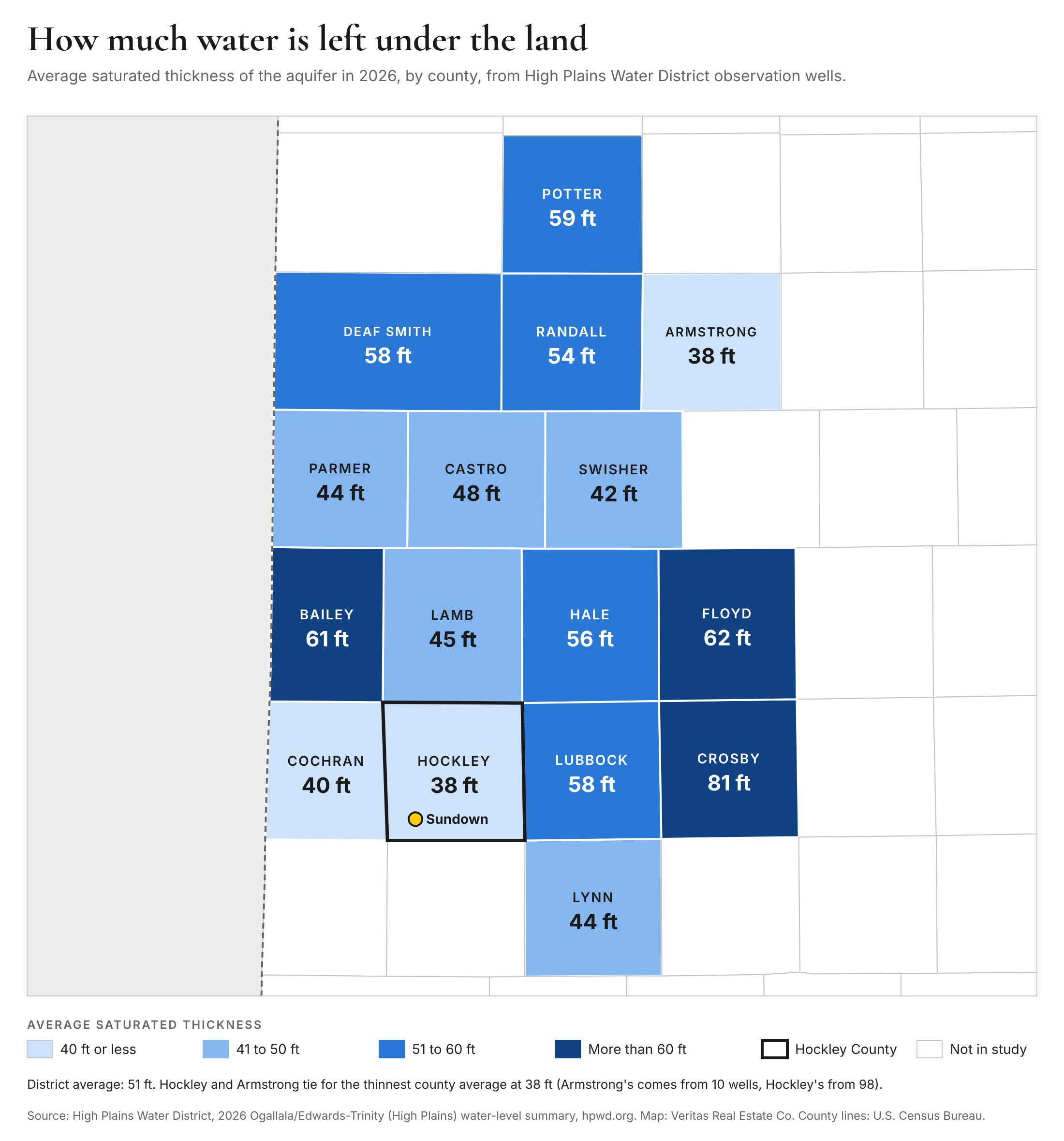
On the South Plains, water comes up fast. In the High Plains Water District’s 2026 measurements, Hockley County averaged 38 feet of water-bearing Ogallala, compared with 61 feet in Bailey County and 58 in Lubbock County. At Sundown, the mayor raised the low aquifer, the local power supply and road damage as concerns.
Your groundwater is part of your property. Texas Water Code Section 36.002 says a landowner owns the groundwater under the land as real property. Find out whether the data center developer wants your water as well as your surface, and what that does to your price and to the land you keep.
Treat the big number as pie in the sky
The price on a data center developer’s letter of intent is meant to get your attention, and it works. Treat it as pie in the sky until the deal closes.
Most of these projects never get built. Bernstein Research estimates only about 35% of announced U.S. data center capacity is likely to be built, roughly 170 of nearly 500 gigawatts, Business Insider reported in October. Nobody publishes a closing rate for data center land options, but if about two out of three projects won’t be built, a lot of optioned land will never close.
So judge an offer by what you get paid along the way, not only by the price at the end.
Option periods run 1 to 3 years, and they’re getting longer
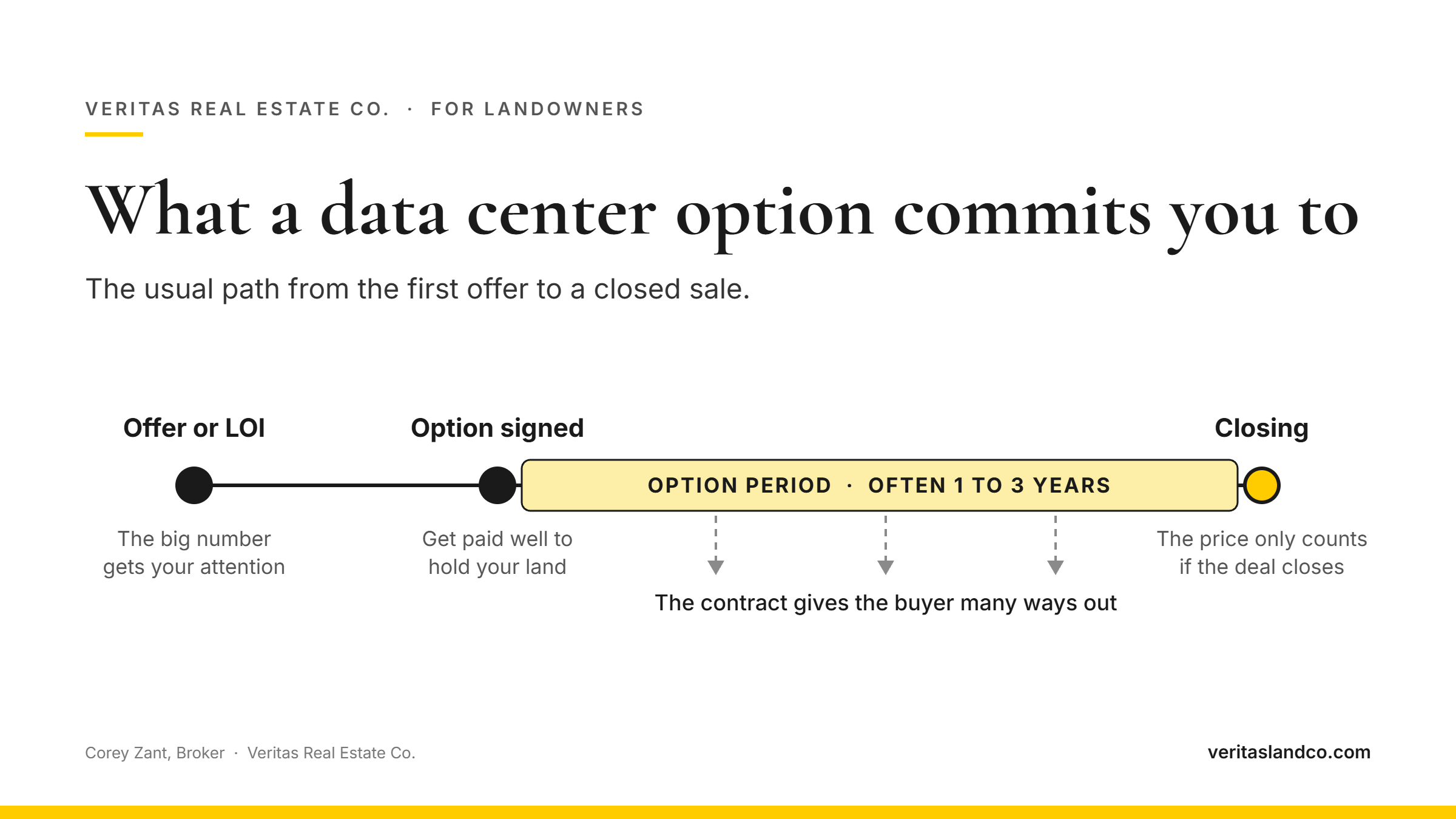
Most of these deals start with an option. The data center developer pays you to hold your land off the market while it studies the site and lines up power, permits and incentives. The option periods I’m seeing run 1 to 3 years, and they keep getting longer.
Two things are stretching them out. The first is the grid backlog: with 474 gigawatts of requests in line at ERCOT, power takes a long time to secure. Gov. Greg Abbott paused permits for some new data centers in August pending an audit, and Gov.-elect Gina Hinojosa has promised a moratorium until new legislation passes, KTTZ reported.
The second is more oversight from city councils and county commissioners as public scrutiny grows. Lubbock held the first of two hearings on a 90-day data center moratorium in November, and Planning and Zoning recommended new zoning rules for large data centers, KCBD reported. Those rules go to the City Council on Dec. 1, and the first vote on the moratorium can come Dec. 10.
Out in the county there is almost no zoning, so the commissioners’ main lever is whether to grant a tax abatement. Tighter city rules can push developers toward county land: near Brownsville, SpaceX’s planned $24 billion site sits on land the city de-annexed at the company’s request, keeping it outside the city’s moratorium, according to the Texas Tribune.
Every one of those steps adds time, and your land is off the market the whole time. That’s why you need to get paid well during the option. A lot of companies try to tie up land for cheap, a small payment to hold your place for years. Negotiate option payments that are worth the wait, that go up with each extension, and that you keep if they walk away.
The 70- to 100-page contract
When a data center developer is ready to move, expect a 70- to 100-page document. They hope you’ll sign it because you’re star struck by the price. Built into those pages are many, many outs for the buyer: ways to extend, delay, renegotiate or walk away.
You have to know what to look out for. That means reading every termination right, every extension and every condition the buyer has to meet before closing, and knowing which ones to push back on. I work through these contracts alongside your attorney so nothing gets missed.
Also plan on the deal going public. These contracts usually carry strict confidentiality clauses, but once an option is signed, a memorandum is typically recorded in the county real property records, where anyone can find it. Know exactly what the confidentiality clause lets you tell your family, your tenant, your lender and your advisors.
Watch out for wholesalers
With the AI boom, a lot of frontrunners are trying to tie up land so they can flip it to an actual energy or data center company. If the deal closes, the middleman carves a large portion out of what the end buyer pays, money that should have been yours. Some site developers do real work, like lining up power before they sell to an end user. Others just hold a contract and hope.
Make sure you’re working with an actual company and not a carpetbagger. Ask who the end user is and what they’ve built. Look up the company on the contract. And check whether the contract lets the buyer assign it to someone else, because an assignable option is how a wholesaler flips your land.
Want a data center offer? Get your land marketed
If you do want to entertain an offer from a data center developer, know how these buyers find land. They work from online resources: land listing sites, parcel data, and maps of transmission lines and pipelines. If your land isn’t marketed, it’s unlikely a real end user will ever find it.
That cuts the other way, too. Anyone who approaches you off market about a data center deal increases the odds you’re talking to a wholesaler, someone hoping to tie up your land before the real buyers see it. A company competing for a marketed property has to pay what the land is worth.
When we list a property, it goes on our website and the national land marketplaces where these companies are searching.
Questions to ask before you sign
- Who is the buyer, and who is the end user? Is it the data center developer that will build, or someone putting sites together to flip?
- Can the buyer assign the contract to someone else?
- How long is the option, and how many times can they extend it?
- How much do they pay you to hold your land, when, and do you keep it if they walk away?
- What are all the ways the buyer can terminate, and what do you get if they do?
- What can they do on your land in the meantime, such as surveys, soil borings or test wells?
- Does the deal include your groundwater or minerals, or only the surface?
- What happens to your farm lease, CRP contract or hunting lease while the land is tied up?
- Will the project need new power lines, roads or a substation, and on whose land?
How we work on these deals
We work for a set commission, paid when the sale closes, and option deals work the same way. We advocate for you, with the goal of getting the highest price per acre, without taking a third to a half of your proceeds like a wholesaler would.
If a data center developer or a land agent calls you, call me before you sign anything. I can tell you what comparable land around you is selling for, so you know what 5 or 10 times market really means on your place, and help you weigh the offer against selling or leasing the usual way.
Corey Zant, Principal Broker, Veritas Real Estate Co. · 806-853-SELL (7355) · corey@veritaslandco.com
Sources
- Texas LAND magazine, Five Questions About Data Centers, Fall/Winter 2026
- Texas Real Estate Research Center, Texas Rural Land Markets, Second Quarter 2026
- Business Insider, Most AI data centers may never be built. Blame the ‘bragawatts.’, October 2026 (Bernstein Research estimate)
- KCBD, Sundown City Council votes to join talks on possible data center, Nov. 7, 2026
- KCBD, Lubbock residents urge council to pass data center moratorium, Nov. 10, 2026
- Texas Tribune, SpaceX to build $24 billion data center in South Texas, sidestepping moratorium, Nov. 10, 2026
- KTTZ, Texans who live near data centers hope for change following election, Nov. 11, 2026
- High Plains Water District, 2026 water level measurements
- Texas Water Code, Section 36.002, Ownership of Groundwater